:strip_icc()/pic7565436.png)
9/10 A spectacular and speedy set-collection game
Update: 10/10
In Knarr, you will run a crew of Vikings and explore and settle lands while recruiting new Vikings to your crew. Don’t get too excited, there’s not a lot of theme here. It’s a simple set-collection card game where you can cash in your sets of cards to buy other cards that can repeatedly generate resources or points.
This is another case where getting the game put on BGA early was a great idea. I was immediately interested in it (I’m somewhat into Vikings) and tried it out on BGA with a friend of mine. We played it a few times, including once with the artifacts module, before I decided I really needed to have the game. But it wasn’t (and as of writing this, still isn’t?) available in the US, but my friend was buying something from a Canadian store that happened to have it in stock. Score!
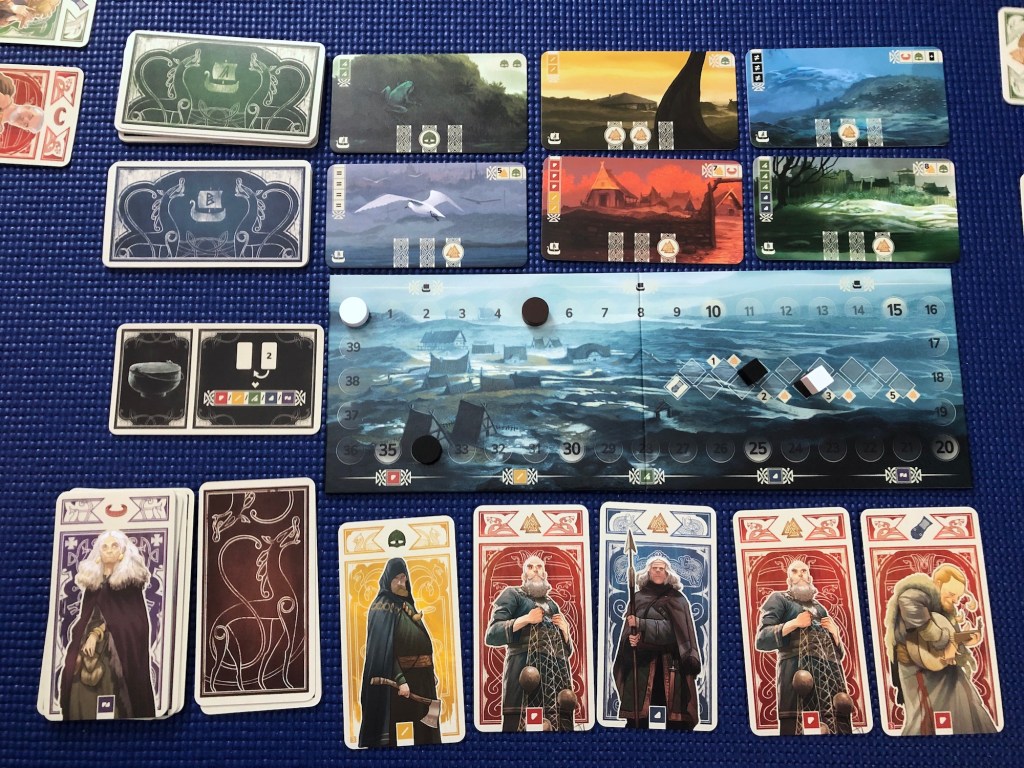
Overview
Knarr is an incredibly simple game. On your turn, you perform one action: Recruit or Explore.
Recruit: You have a hand of 3 Viking cards. On your turn, play one in front of you and collect whatever it gives you. If it matches the color of any Vikings already in front of you, you get the rewards of each of those Vikings. Then, you can either take the Viking card in the matching colored slot of the main board (adding it to your hand) or spend a recruit token to take any Viking card from the main board.
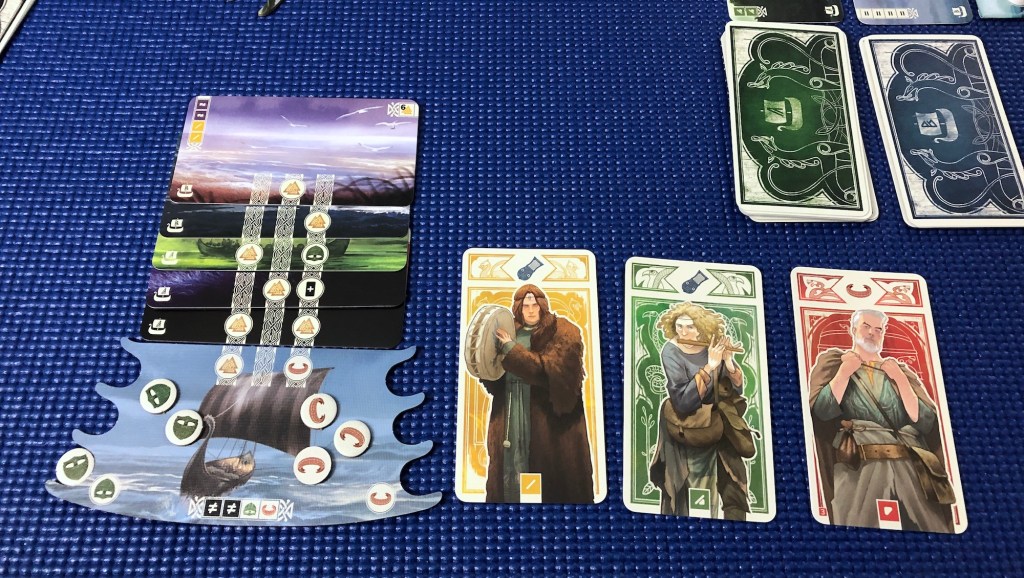
Explore: Instead of playing a card, you can spend Viking cards from in front of you to explore Destination cards. Each one costs a specific set of cards; particular combinations of colors, cards of the same color, or cards of different colors. Recruit tokens can also be spent to help pay the cost (including the entire cost if possible). Once explored, you collect whatever is in the top right corner (additional resources or points), then place the card above your ship, adding to your rewards when you trade.
Trade: Before or after your action, you can spend bracelet tokens to trade and collect the resources from your ship and all lands you’ve explored (cards placed above your ship). Trade rewards are split into three columns and each column you want to collect from costs 1 bracelet, but you must go from left to right. You can’t skip a column.
The game continues until one player has reached or passed 40 points. You finish the round. Most points wins. There’s nothing to tally at the end.
Theme
There are elements of theme here and there, but really, it’s a simple set-collection game. But I do have one main issue with the game in this regard, especially since the rule book’s forward credits a “senior lecturer” on the topic. That is, the rules and the forward insist that basically, any Scandinavian who gets on a ship is a Viking. Merchants, explorers, settlers. They’re all Vikings.
No! Historians and scholars have been trying to fight against the generalizing of the term “Viking.” A Viking is predominantly a raider. There are some instances where traders who sailed far to foreign lands were also considered Vikings, but in most cases, if you want to use the term Viking, you should only use it to refer to those engaged in raiding or warfare overseas. Simply being Scandinavian on a boat doesn’t make you a Viking. But I get it, it’s a simpler definition for the game.
Mechanisms

Other than set collection, which comes in two forms here, the act of drafting a card from the main board is an important element. You’ll be keeping an eye out for Vikings that match colors you’re already invested in. Being able to re-trigger rewards from Vikings by playing matching colors is not only more efficient but often necessary to be able to pay for Destination cards.
Trading offers a sense of engine-building, as can playing Vikings if you’ve built up a strong stack of one color. But in both cases, you won’t be running your engine too often. If you get lucky, you might trade a handful of times during the game, but otherwise, you might only get to do it a few times (and maybe not all of your columns).
Overall, it’s amazing to see how a few simple mechanisms all work together to make the game feel much bigger and more complex than it really is.
Components
While the artwork is very pretty and there were some nice elements to the production (linen finish cards, functional insert that includes tuck boxes), there are a few minor problems.
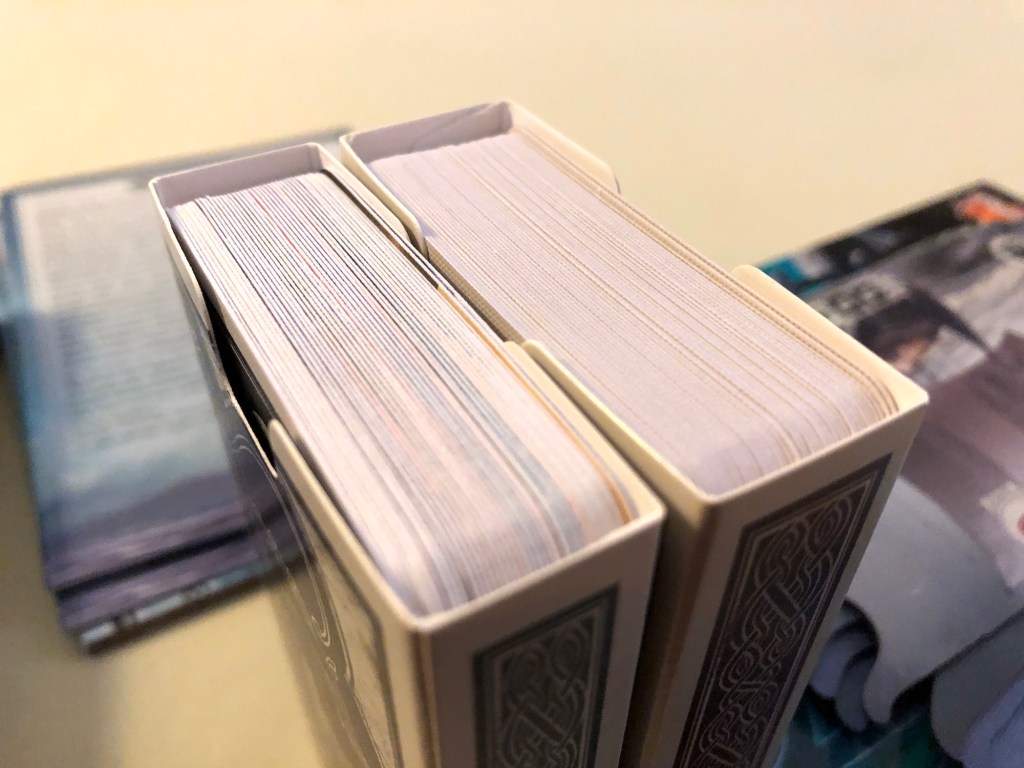
For one, the tuck boxes are a bit tight. They barely fit the cards back into them, and the cards won’t fit fully flush. That said, my photo won’t truly illustrate how the game comes because my tuck boxes seem to have loosened up some and the cards fit into them a little better. Not quite flush, but close enough. So this will probably be a non-issue after some time.
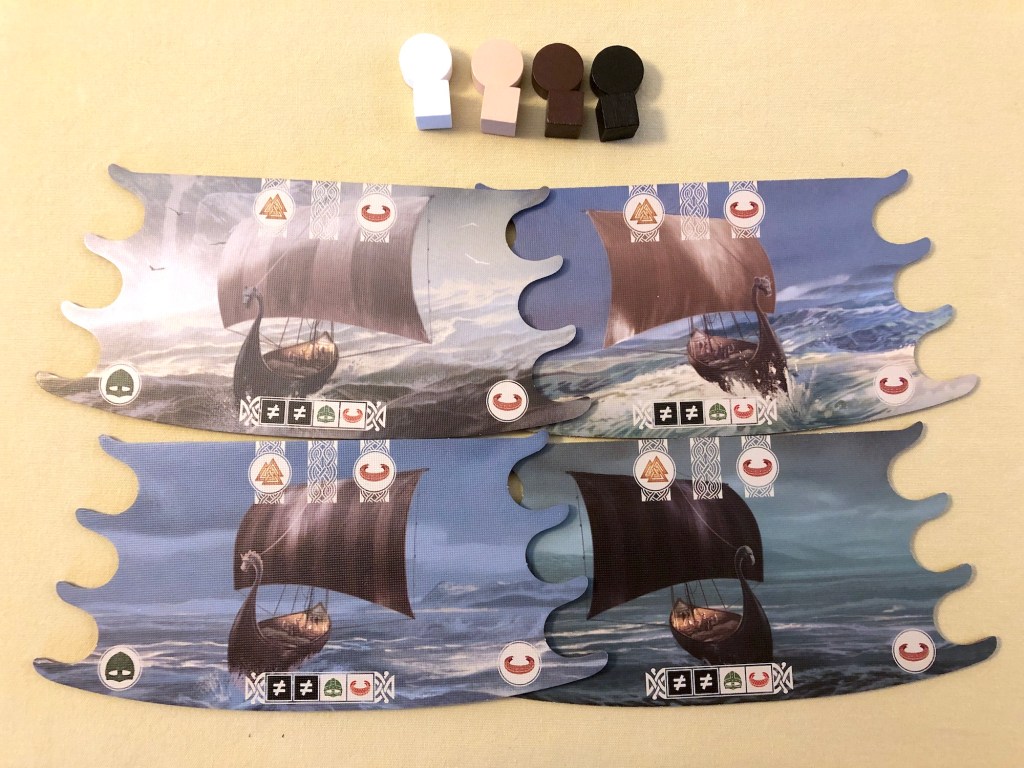
The player ships and pieces are also not great. White and black, sure, but then light brown and dark brown. The ships in particular are hard to tell apart at a glance without looking at all of them together. Just earlier when I played solo, I took the dark brown ship at first, thinking it was the black ship. The tokens aren’t much better with the dark brown and black being very close. The reputation track is also a problem when too many players have the same reputation and have to stack their cubes. It becomes a dexterity game because the track is just too small for its purpose. The ship boards also don’t fit the recruit and bracelet tokens very well. They will sometimes get stuck in their slots.
It’s also just odd that the “silver bracelet” icon is rather copper-looking.
Rules Clarity and Balance
Overall, there’s not much to say about the rules. However, there has been some confusion about the timing of the artifacts in the included module. The designer clarified that unless an artifact modifies your action (like the Cauldron), you resolve the artifact immediately after your action, before your optional Trade.
Conclusion
There seems to be an impressive number of different strategies and nuanced tactics to explore in Knarr despite how incredibly simple it is. And adding the artifacts lets you shake things up and explore new tactics. I also tried out a fan-made solo variant that seems to work pretty well. Knarr has been a huge hit for me, and I highly recommend it to anyone who enjoys simple but engaging puzzles.
 Thomas P. King, author and game designer